Card Evaluation in a Roguelike Deckbuilder: A Quick Test
5 min read
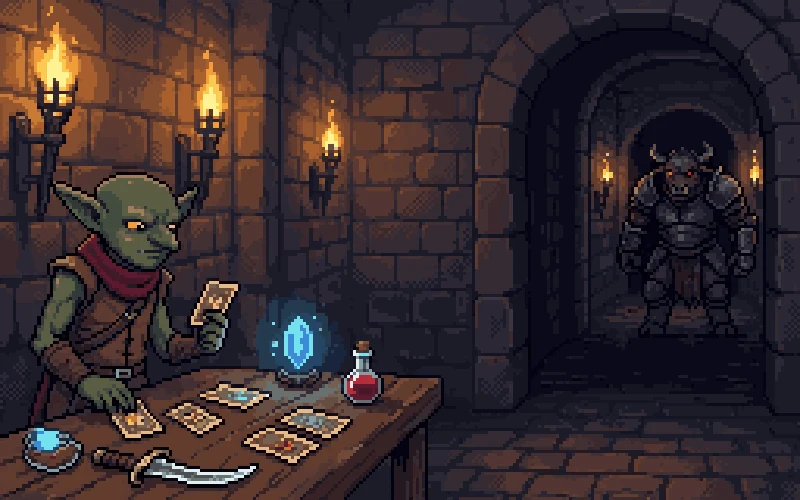
Card evaluation in a roguelike deckbuilder gets easier when you give every pick the same practical test. Ask what problem the card solves now, what it costs your deck, and whether you can expect it to matter in the next encounter. That keeps impressive text from doing all the persuading.
Card evaluation in a roguelike deckbuilder starts with a problem
Before reading a reward as a list of cool effects, take stock of the next threat. Are you losing health because enemies hit hard? Do you struggle to finish fights before damage adds up? Are turns awkward because your hand rarely offers useful actions together? A card is valuable when it helps with a problem your run actually has.
This makes card value depend on context. A defensive card can be excellent when incoming damage is the main danger, while a damage card may matter more when a threatening enemy needs to go down quickly. The same pick can look different later, after your deck or route changes.
Use the next encounter as a short-range check. Picture drawing the card in the first few turns. What would you play instead? Would the card prevent damage, improve your options, or help end the fight? If the answer is hard to name, its immediate role may be weaker than its description suggests.
- Name the current weakness in one sentence.
- Imagine the card in the next likely fight.
- State the specific outcome you expect it to improve.
Compare the card with what it would replace
A reward does not enter an empty deck. It joins the cards already competing for draws, and it may make the deck less consistent if it duplicates a job you can already handle. Compare the new card with the weakest card or role in your current deck. Does it improve that slot, cover a gap, or add another option you can use reliably?
This is especially useful when a card looks powerful in isolation. A large effect may still be a poor addition if it overlaps with several cards you already draw often. A modest effect can earn its place by covering a missing function, such as adding defense to a deck that mostly attacks.
Think about access as well as strength. In a larger deck, any individual card may appear less often. That can be worth it when the card has a distinct job. If it is only slightly better than what you have, the extra draw competition can outweigh the upgrade.
For a closer look at draw reliability and useful overlap, see this guide to roguelike deckbuilder deck consistency.
- What card or job does this addition compete with?
- Does it add a capability the deck currently lacks?
- Will the deck still find its important tools often enough?
Count energy and hand space as real costs
A card's printed cost is only part of its price. Playing it uses energy that could have gone toward another action. Drawing it also takes a place in your hand, and it can feel clumsy when you cannot afford to use it on the turn it appears.
Ask how often the card's cost fits your usual turn. A high-cost card can be worth the commitment when the impact is substantial and the deck has ways to reach that turn safely. If your turns already feel crowded, another expensive option may sit unused while smaller actions compete for the same energy.
Low-cost cards have their own trade-off. They are easier to fit into a turn, but a deck packed with small effects may lack the impact needed to handle a dangerous enemy. Look at the whole turn: what combination of actions can you realistically play, and what does this card crowd out?
Hand quality matters too. A situational card can be powerful in the right moment and awkward elsewhere. When judging it, count the turns when it has a useful target, not only the turn where everything lines up.
- Can you afford the card on a typical turn?
- Which other action would lose energy or hand space?
- How often will its conditions or target be available?
Treat synergy as a probability, not a promise
Synergy can turn a good card into a strong one, but a combo that rarely appears together is mostly an idea. Check what the card needs, then count how many pieces your deck already has and how often they can meet. A reliable interaction with a card you draw regularly deserves more weight than a chain that depends on several future rewards.
You do not need to reject every setup card. Some effects improve a deck over several turns or make later choices stronger. The practical question is whether the setup has a payoff you can access, and whether the setup turn leaves you safe enough to reach it.
A useful test is to imagine drawing the card without its ideal partner. Does it still contribute something? If it has a reasonable standalone use, the synergy can be upside. If it does almost nothing alone, count it as a commitment and be cautious about adding more pieces before the deck can support them.
For a step-by-step framework on spotting and committing to card interactions, read how to build synergies in roguelike deckbuilders.
- Identify the exact card, condition, or timing the synergy needs.
- Check whether the deck can access those pieces together.
- Give extra credit when the card has a useful independent role.
Revisit the pick after a few fights
A card choice is a forecast. After a few encounters, compare that forecast with what actually happened. Did the card appear when useful? Did its cost fit your turns? Did it help solve the weakness you picked it for? These questions help you adjust future decisions without turning one draw into a verdict.
Keep the review focused on patterns. A card that sits unused once may have been unlucky. If it repeatedly arrives without a good play, the issue could be its cost, its narrow role, or a mismatch with the deck. A card that keeps making ordinary turns smoother may be doing more work than a dramatic effect that only fits one rare situation.
This is also where encounter planning matters. A pick that helps against an upcoming elite can be sensible even if it is less useful in routine fights. Route and risk affect the value of your tools, so pair card evaluation with a route-planning checklist when the map offers different kinds of challenges.
A quick note after a fight can be enough: what problem was the card meant to solve, and did it help? Over time, that simple habit makes deckbuilder card choices less about guessing from card text and more about understanding how your deck functions.
- Review several draws before deciding a card is a failure.
- Look for recurring dead turns or useful contributions.
- Update your next pick based on the deck you have now.
Tower Trials is a dark-fantasy roguelike deckbuilder about Nibs, a goblin scavenger climbing a 100-floor dwarven tower, with five archetypes: Miner, Tinker, Brewer, Runes, and Wall. It is free to play, with one optional purchase to remove ads; learn more on the homepage.
Play Tower Trials today on mobile