Deck Thinning Strategy: When Less Is More
6 min read
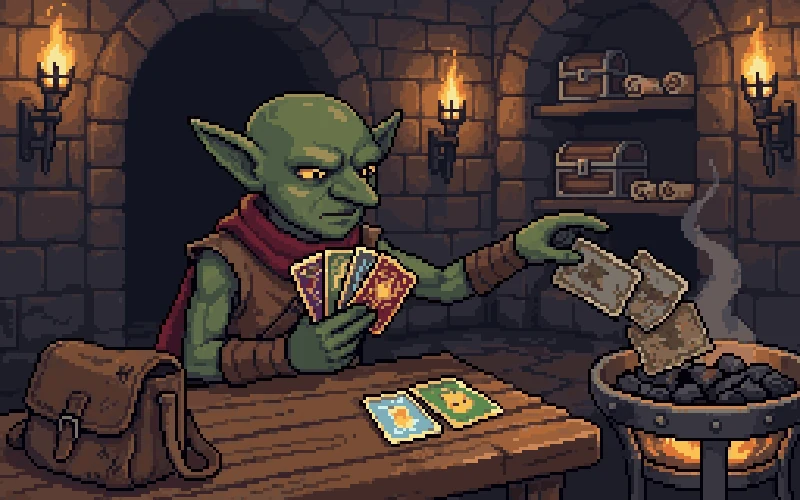
A deck thinning strategy roguelike deckbuilder players can use starts with a simple question: which cards are getting in the way of the turns I want to make? A smaller deck can bring useful cards around more often, but trimming cards without a plan can leave you short on damage, defense, or answers to a particular fight.
Deck thinning strategy roguelike deckbuilder math, in plain terms
Imagine a deck with 15 cards, including 3 cards you rely on. If you draw 5 cards from a shuffled deck, each of those key cards has a better chance of showing up than it would in a 30-card deck with the same 3 key cards. That is the basic appeal of thinning. The exact odds depend on the game's draw rules, reshuffling, and effects that search or draw cards, so treat the comparison as a useful model rather than a universal calculation.
The model only helps if the cards left behind are worth drawing. Removing a card that covers a weakness can make the deck less reliable, even as it makes another card more frequent. A deck with one strong attack and no way to block can be consistent at doing the wrong thing. Ask whether a removal improves your overall set of likely turns, rather than whether it makes one favorite card appear sooner.
For a more detailed look at the probability side of consistent draws, see roguelike deckbuilder deck consistency. The practical takeaway is to judge card count alongside the number of useful plays your deck can make.
Signs your deck needs thinning, beyond its size
A deck can feel bloated at 18 cards or run smoothly at 30. Look at what happens across several fights. Do you keep drawing cards that have stopped helping? Are your strongest effects arriving after the dangerous part of a battle? Do you have several cards that ask for the same resource or setup, while your deck lacks a response to common threats? Those are clearer warning signs than a particular card-count target.
Check for overlap before you remove anything. Two cards can look similar and still serve different jobs. One might give immediate defense while another scales into a long fight. If both compete for the same moment and one is consistently less useful, that weaker copy may be a sound removal candidate. If each covers a distinct situation, keeping both may improve the deck's range.
Also check whether the problem is actually card quality. A useful card can appear at the wrong time because the deck lacks draw, or because another card needs setup. Removing it may hide the symptom rather than solve the cause. My quick test is to name the job a card does, then name a situation where that job matters. If I cannot answer either, the card is a stronger candidate for removal. The card evaluation guide has a related framework for weighing cost, immediate value, and deck fit.
When to remove cards and when to leave them alone
When to remove cards deckbuilder players often ask about depends on what removal costs and what the run needs next. Before spending a removal opportunity, compare the card's future value with the benefit of seeing the rest of your deck more often. A weak starter card is a common candidate because it may have little late-run use. A defensive card may deserve to stay if upcoming fights punish low defense, even if it looks plain beside your flashy damage cards.
Use this short decision check at a removal event. First, name the card you would remove and the exact reason. Second, ask what useful role disappears with it. Third, consider whether an upcoming boss or elite changes the answer. If you still have a clear target and the event has no better competing use, removal is likely worthwhile. If every possible target fills a real need, saving the opportunity can be the disciplined choice.
Curse cards roguelike players encounter need their own check. Their effects differ by game, so read the actual text and consider how often the card enters your hand or interferes with a turn. A curse that imposes a meaningful cost each time it appears can be a high-priority removal. One with a modest or conditional drawback might wait while you handle a more urgent weakness. Never assume every curse has the same severity.
When to skip a card reward entirely
Skipping a reward is a form of deck size management. A new card should earn its place by improving a matchup, strengthening a plan, or giving the deck a tool it currently lacks. If it does none of those things, adding it may dilute the cards you already rely on. That is especially worth considering when a reward offers a card that is merely acceptable, while your deck already has enough ways to perform that job.
There are good reasons to take a card that is not an obvious upgrade. Your deck may need a second way to deal damage, a defensive option for a coming boss, or a card that enables a useful combination. Think about the next stretch of the run as well as your ideal final deck. A narrow but timely answer can be more valuable than a broadly appealing card that will take a long time to matter.
A useful reward rule is to finish this sentence before taking a card: 'This helps because...' If the answer names a specific gap or combination, consider the pick. If the answer is only 'it looks strong,' compare its cost and role with cards you already own. The broader guide to building synergies can help identify when a new card supports an existing plan.
Removal events, relics, and keeping your plan flexible
Removal events vary from game to game. Some offer a direct trade between removing a card and spending a resource. Others attach removal to a location, reward, or additional choice. I avoid treating all of them as interchangeable: read what the event asks you to give up, then compare that cost with the value of the specific card you would remove. A free removal can still be a poor choice if it strips out an important answer.
Relics and similar passive effects can change the value of thinning. An effect that rewards a larger deck, benefits from playing more cards, or changes how often you see certain cards may make the usual small-deck instinct less useful. Conversely, effects that reward repeated access to a key card can make targeted thinning more attractive. Read the full effect and reassess after gaining it. A plan that made sense before a relic can shift once the relic changes what your deck is good at.
For deck size management tips, keep a tiny running note after fights: what did I draw too late, what sat unused, and what role was missing? Patterns across several battles are more informative than one awkward hand. Then use map choices and upcoming encounters to decide whether you need removal, a new answer, or simply time for your current deck to come together. This keeps thinning in service of the run rather than turning it into a goal of its own.
Tower Trials is a dark-fantasy roguelike deckbuilder for iOS and Android, with five archetypes: Miner, Tinker, Brewer, Runes, and Wall. It's free to play with one optional purchase to remove ads; learn about Tower Trials.
Play Tower Trials today on mobile