How Many Cards Should a Deckbuilder Deck Have?
6 min read
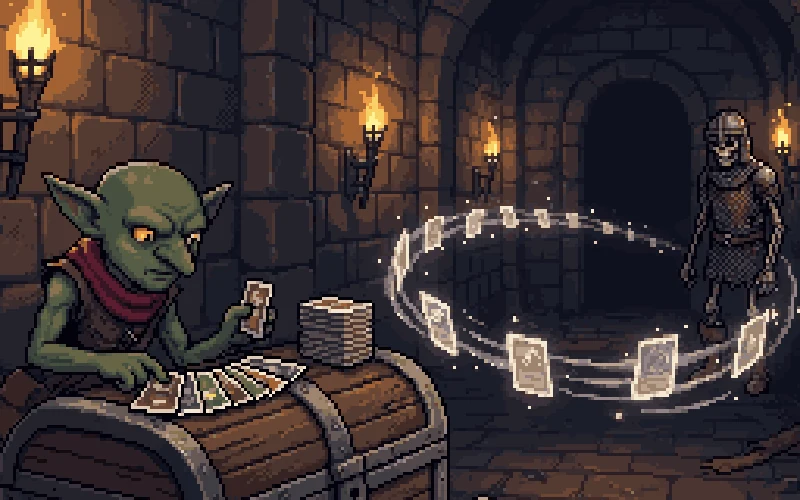
The answer to how many cards in a deckbuilder deck depends on what those cards need to do, how quickly you draw them, and how long a fight lasts. A small deck can make key cards appear more often, while extra cards can cover gaps or support a plan. Use those tradeoffs to find a useful size for your run, rather than chasing one supposedly perfect number.
Why there is no universal ideal deck size
A deck's size only tells part of the story. Two decks with the same number of cards can behave very differently if one has reliable draw and the other has several expensive cards competing for limited energy. The deck's contents, its draw tools, and the pace of its fights all affect how often you see the cards you want.
In a constructed card game, a format may set a required minimum or exact size. Roguelike deckbuilders often ask you to add cards during a run, so the more useful question is how many draws you can expect before a fight is decided. A deck that cycles quickly can support more cards than one that rarely sees its discard pile reshuffled.
Think of the deck size roguelike deckbuilder question as a timing question. If a fight ends before you reach the bottom of your deck, cards near the bottom may never matter. If the fight lasts long enough for several cycles, you can include more situational answers, provided those cards still earn their space.
- Estimate how many cards you see in an average turn.
- Notice when your discard pile returns to your draw pile.
- Compare that cycle time with the length of ordinary fights and boss fights.
Count useful roles, not just cards
Start by listing what your deck must handle. Most decks need ways to deal damage, prevent or recover from damage, and make their main plan work. A card can fill more than one role, and that flexibility is valuable because it gives you useful options in more hands.
Then look at access. A deck may have enough defense on paper, yet still take heavy damage when its defensive cards appear late. Likewise, a powerful payoff card has limited value if the cards that enable it are rare or awkward to play. For each important role, ask whether you have enough copies or draw to see it on time.
This is a better test than asking whether your deck is 'small' or 'large.' Ten cards that all do the same job can leave a serious hole. A larger deck with overlapping answers may handle more situations, especially if its cards work together. For a closer look at evaluating an individual pick, see my card evaluation guide.
- Mark the jobs your deck needs to perform.
- Check whether key cards need another card or condition to be useful.
- Look for essential roles that appear in too few draws.
When extra cards improve a deck
Adding a card makes sense when it provides a job your current deck lacks. That might be a reliable answer to a threat, a way to defend while advancing your plan, or a useful payoff for a synergy you already have. The important part is that the new card changes what your deck can do, rather than simply adding another version of a role you already cover comfortably.
Extra cards can also make sense when they connect separate parts of a deck. A card that is decent on its own may become valuable if it supports several other cards, or if it gives you a useful option in fights where your main plan is poorly suited. Synergy is more dependable when the supporting cards still have a purpose when they arrive separately.
Pay attention to the cost of adding a card in opportunity. If your deck already draws plenty, or if its central cards are easy to access, one more useful option may be worth the dilution. If your deck struggles to find its core pieces, another situational card can make that problem more visible. My guide to building deck synergies goes deeper into checking whether card interactions support a plan.
- Add cards that cover a real gap or improve a clear plan.
- Prefer flexible cards when several roles are still underfilled.
- Consider whether the card will help in the fights you expect soon.
When a large deck hides a consistency problem
A large deck consistency card game problem often starts with a reasonable decision. Each reward looks useful on its own, so the deck keeps growing. Over time, though, important cards show up less often, and the deck may contain several plans without enough support for any one of them.
Watch for repeated signs rather than blaming the total. Do you often draw cards that need setup you do not have? Are there turns where every card is playable but none helps with the immediate threat? Does a key defensive or damage option arrive after it would have mattered? Those patterns point to a deck-quality issue, and adding more cards without a clear reason can deepen it.
Draw changes the calculation, but it does not erase it. More draw means you see more of the deck over time, yet draw cards also take space and may have costs of their own. Ask whether the draw arrives early enough and whether it helps you reach cards that improve the current hand. For related advice on trimming clutter, read the deck thinning guide.
- Look for cards that regularly arrive without the pieces they need.
- Check whether your draw improves access or merely adds another step.
- Skip a reward when its role is already well covered.
Test your deck using a few real turns
To judge deck size and card draw, use a simple thought experiment. Pick a common fight and imagine the first few turns using the cards your deck is likely to draw. You do not need exact probabilities. Ask whether the opening hand can respond to pressure, whether your next turns have useful choices, and whether the deck reaches its important cards before the fight is effectively over.
Repeat the check for a longer fight. A deck that handles ordinary enemies may run short of defense in a boss battle, or take too long to assemble its damage plan. Consider how many turns your deck needs to show its core cards, then compare that with the time the fight gives you. Boss planning has its own wrinkles, which I cover in this boss preparation guide.
Finally, change one thing at a time. If important cards arrive too rarely, consider whether you can remove weak cards or improve draw. If you lack a needed role, add a card that directly fills it. If hands are full of situational options, skip similar rewards and see whether the next few fights become easier to read. The goal is a deck whose size matches its jobs and cycle time, not a number you can copy from someone else's run.
- Use a short fight and a long fight as separate checks.
- Identify the specific turn where the plan falls apart.
- Make one adjustment, then reassess the same problem.
I make Tower Trials, a dark-fantasy roguelike deckbuilder for iOS and Android, where you climb a 100-floor dwarven tower and build around five archetypes: Miner, Tinker, Brewer, Runes, and Wall. It's free to play, with one optional purchase to remove ads. Learn about Tower Trials.
Play Tower Trials today on mobile