Roguelike Deckbuilder Energy Management: Spend Each Turn Well
6 min read
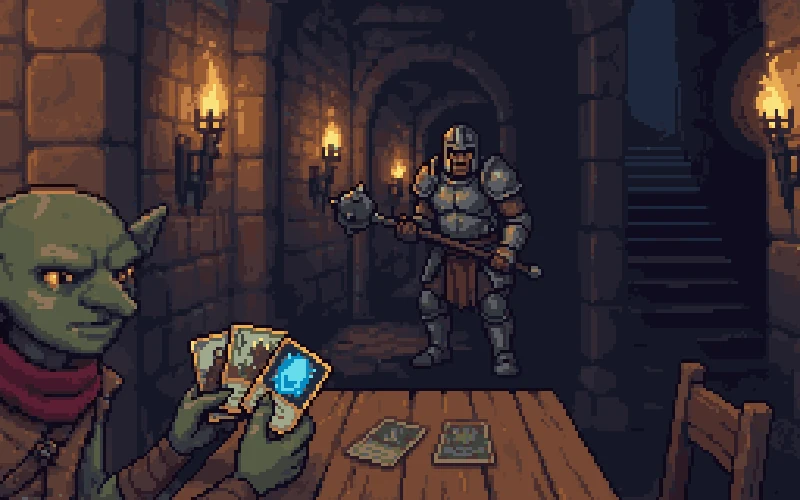
When your hand has more useful cards than you can afford, energy management becomes a prioritization problem. A steady turn-by-turn check can help you protect your health, advance your plan, and avoid spending energy simply because it is available.
Roguelike deckbuilder energy management starts with the threat
Before choosing cards, look at what the enemy is about to do and what happens if you leave that action unanswered. An attack aimed at your remaining health may deserve immediate defense. A small hit might be acceptable if spending energy on defense would leave you unable to stop a more dangerous enemy or end the fight sooner.
Give the turn a short job. It might be to blunt the largest incoming hit, remove a dangerous enemy, or establish a setup effect that matters later. That job gives you a way to compare cards with different purposes. If two cards compete for the same energy, ask which one helps with the urgent problem more reliably.
This is not a fixed rule to always block first or always attack first. The value of each action depends on the fight's clock. If an enemy is close to defeat, damage may prevent more harm than defense. If a threat will remain active for several turns, a defensive card can buy time for your deck to do its work. For a fuller approach to enemy intent and turn timing, see this boss fight guide.
- Identify the most consequential enemy action coming up.
- Estimate the cost of taking that action without responding.
- Choose a turn goal before spending energy.
Compare energy cost with actual impact
A card's printed effect is only part of its value. Its practical impact depends on what it changes right now, how much energy it uses, and what other cards you could play instead. A costly attack can be efficient if it crosses a threshold that removes an enemy or prevents another dangerous turn. A cheap card can be a poor choice if it barely affects the current situation.
For each candidate, consider three questions. What changes if I play it? What do I give up by paying its cost? Does the effect help this fight's immediate problem or a plan that needs more turns to pay off? This quick comparison keeps energy focused on meaningful outcomes rather than on card cost alone.
It can help to compare cards by their marginal value. If an enemy will survive either way, a small extra attack may not change the next turn. If that attack finishes it, the same damage has much greater value. Defense works similarly: a little shield may be enough to reduce a large hit, while extra defense beyond what you need might have less immediate impact than another action.
For a repeatable way to judge a card's cost, effect, and fit with your deck, use this card evaluation guide. The key habit is to judge the card in the situation you have, rather than treating its cost as a complete measure of efficiency.
Avoid spending energy on low-value actions
Unused energy can feel like a mistake, especially when the turn ends with a card still in hand. But playing every affordable card is not automatically efficient. A weak action that does not change the threat, support your plan, or improve your next turn may use energy that could have gone toward a more important card.
Try comparing an action with the best alternative available. If you can play a small attack or a defense card that prevents a large amount of damage, the defense may be the better use of the pool. If neither choice changes the outcome much, it may be reasonable to spend elsewhere in the turn or accept that the hand did not line up well.
Setup cards call for a similar check. A scaling effect can be valuable when the fight will last long enough to benefit, but it costs energy now. Before playing it, consider whether the remaining actions still cover the immediate danger. If the setup leaves you exposed, delaying it by a turn may be the more efficient choice.
The goal of a deckbuilder energy strategy is not to maximize the number of cards played. It is to spend energy where it changes the likely outcome. Sometimes that means a full turn of useful actions. Sometimes it means one strong play and a deliberate pass.
Plan for awkward hands and uneven costs
Some turns offer several expensive cards and no clean combination. Others bring low-cost cards that do not fit together. That is a normal deckbuilding problem, and it is worth deciding early what a workable fallback looks like. If the hand cannot support the ideal sequence, choose the action that protects the run or preserves the most useful part of your plan.
When possible, play cards that help you see more options before committing the full energy pool. A draw effect can reveal a card that changes your priorities, though it also has a cost and may not find what you need. Check the order of operations carefully. Spending most of your energy before drawing can leave you unable to use a newly revealed card.
Uneven costs also affect how many actions fit into a turn. A collection of cheap cards can offer flexibility, while a hand of high-cost cards may force a sharper choice. When building or adjusting a deck, consider whether its costs give you realistic ways to act on turns when you draw an awkward mix. A deck with powerful cards can still feel clumsy if many of them compete for the same limited resource.
If a turn has no clean answer, avoid forcing one. Protect the most important resource you can, take the best available action, and use the next turn to adapt. This is one reason that deck consistency matters: reliable access to useful actions makes limited energy easier to allocate.
How relics and upgrades change your choices
Relics and card upgrades can shift what counts as an efficient turn. An effect that reduces a card's cost may let you combine it with another action. A stronger version of a card may change whether it is worth prioritizing. A relic may reward a particular kind of play or make a previously awkward sequence more practical.
Whenever your deck changes, revisit your assumptions about energy. A card that used to consume most of a turn may now fit beside a defensive action. A stronger attack may make it possible to end a fight earlier, changing how much protection you need. These changes are easiest to notice when you ask what the new option lets you do, rather than focusing only on its individual numbers.
Avoid building a plan around a bonus before you know how often it will matter. If an upgrade improves a card you rarely draw, its effect on your typical turn may be modest. If a relic rewards an action that already suits your deck, it may make that plan more dependable. The best response is to check the whole turn: what can you now afford, what danger remains, and what does the extra effect help accomplish?
A useful final check is to ask whether your current energy use supports the next few turns as well as this one. An upgrade can make a single play stronger, while the broader question is whether your deck can repeatedly turn energy into defense, damage, or setup when it needs to.
I make Tower Trials, a dark-fantasy roguelike deckbuilder and card RPG for iOS and Android with five archetypes: Miner, Tinker, Brewer, Runes, and Wall. It is free to play, with one optional purchase that removes ads.
Play Tower Trials today on mobile