Why Your Deckbuilder Deck Feels Too Big
6 min read
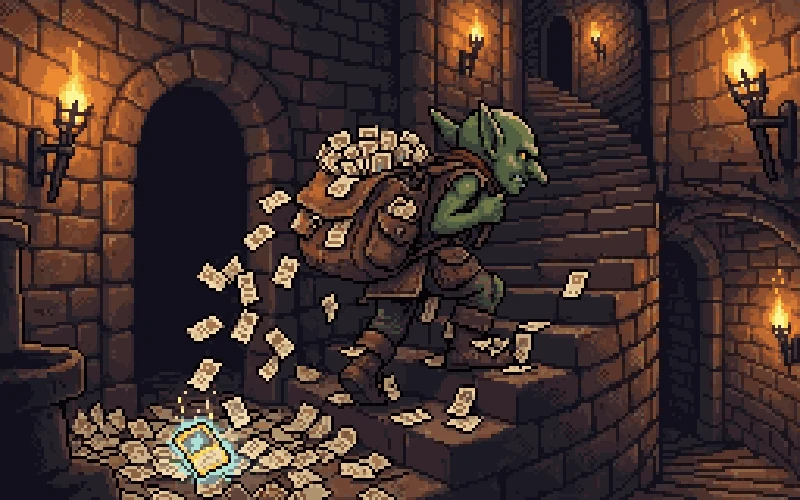
If you keep thinking, "why deckbuilder deck feels too big?", the card total may only be part of the problem. A deck can feel bloated because a crucial card arrives too rarely, several cards compete for the same job, or the deck takes too many turns to cycle. Here's a practical way to tell those problems apart before you start removing cards at random.
Why deckbuilder deck feels too big: start with the draws
A large deck can still produce useful hands. A smaller deck can still feel clumsy if its cards need the same resource, depend on a missing setup piece, or do little for the fight in front of you. Raw count matters because it affects how often you see each card, but it doesn't explain every awkward turn.
Start by naming the failure you notice. Are you waiting for one particular attack or defense card? Do you draw several cards that all build toward the same plan, with no card that helps you survive right now? Or does the fight end before your deck comes around again? Those clues point to different fixes.
This distinction helps with deckbuilder deck bloat. If key cards are buried, the deck may need more consistency or fewer distractions. If the hand has plenty of cards but none fit the current threat, the problem may be role balance. For a broader look at card totals and cycling, see how many cards a deckbuilder deck needs.
- Key effect rarely appears: check frequency and draw access.
- Hand is full of similar effects: check role overlap.
- Useful cards arrive after the fight's main danger: check cycle speed and turn timing.
Count how often a key card appears
Pick one card or effect you consider essential, then ask how often it appears before the fight is decided. You don't need a spreadsheet. For a few fights, note whether it showed up early, late, or not at all, and whether you had the resources to play it when it did.
A simple probability check can clarify the feeling. If your deck has 20 cards and you see 5 different cards before reshuffling, one specific card has roughly a one-in-four chance of appearing in those five. With 30 cards, that falls to roughly one-in-six. These are rough estimates for a draw without replacement; extra draws, starting hands, and cards that change the deck can shift the result.
That doesn't mean every deck should be made as small as possible. A card that appears in a quarter of those early draws still may not help if it costs more than you can afford, or if its effect matters only after another card. Check the whole chain: does the setup arrive, can you pay for it, and is there enough time for its payoff?
When a key card keeps showing up too late, consider whether you can improve access, add another card that performs the same essential job, or remove low-impact cards. Each option has a cost. More copies may make the deck repetitive, and removal may use a resource that would solve a more urgent problem. The guide to roguelike deckbuilder deck consistency goes deeper on reliable access.
Look for cards that overlap without adding coverage
Two cards can share a role and still belong together. Multiple ways to deal damage, defend, or draw can make a deck more reliable. The warning sign is overlap without a useful difference: several cards solve the same narrow situation, while another important situation has no answer.
Think in terms of coverage rather than labels. If three cards all need a safe setup turn, they may crowd out immediate defense. If several defensive cards each help in a different way, they could work well together. Ask what each card contributes when drawn alone, then what changes when it appears beside its closest lookalike.
A useful test is to imagine removing one of the overlapping cards. What specific turn becomes harder? If you can name a real gap, the card may be providing insurance. If the answer is only that the deck would have fewer cards, its slot may be doing little. Also consider how often the two cards compete for the same limited resource.
This is especially important when a synergy has started to form. A new card can look like a perfect fit because it shares a theme, yet still make hands less playable if it requires the same setup as everything else. For a structured way to assess a reward, use this card evaluation test.
When to stop taking rewards
A card reward is an option, not an obligation. Before taking one, give it a job. Maybe it covers a weak matchup, adds a dependable answer, or completes a plan that already appears often enough. If you can't describe what turn or problem it improves, skipping can protect the deck's focus.
This matters when your deck already has a working answer for the next threat. Another damage card may be less valuable than a defense option, but only if defense is the gap you actually have. Compare the reward with the cards you already draw, the resources those cards demand, and the fights or hazards you expect to face soon.
Taking fewer cards can improve access to the cards you value, but excessive restraint can leave the deck without enough tools. A thin deck of similar effects can struggle just as much as a large deck with poor focus. Revisit the question after each major reward: what weakness did this card address, and what weakness remains?
Card removal can help when a weak card regularly dilutes useful draws. It has less value when the main issue is a missing role, or when another use of the same resource would prevent more damage. The decision guide to card removal timing lays out that tradeoff.
Use a short run review to find the cause
After a rough fight, write down three things while the sequence is fresh: what card or effect you wanted, what you actually drew, and what the enemy did before you could respond. That tiny review separates an unlucky draw from a repeated structural problem.
If the same key effect arrives late across several fights, look at deck size, draw, and access. If you repeatedly draw several cards with the same purpose, check overlap and resource competition. If the deck seems to work once it cycles but the fight is already nearly over, focus on early-turn impact and how long the cycle takes.
Keep the review specific. "My deck is bad" gives you nothing to change. "I had setup cards in three opening hands and no answer to the first attack" gives you a clear question for the next reward or upgrade. One fight can be noisy, so look for a pattern before making a drastic change.
The goal of deck size deckbuilder strategy is to make useful decisions show up often enough, while keeping enough role coverage to handle different fights. Treat the card total as a clue, then trace the missed turn back to access, overlap, timing, or a missing answer.
I'm making Tower Trials, a dark-fantasy roguelike deckbuilder for iOS and Android, with five archetypes: Miner, Tinker, Brewer, Runes, and Wall. It's free to play with one optional purchase to remove ads; visit the Tower Trials homepage.
Play Tower Trials today on mobile